
2025 is coming to an end, and it’s a good time to reflect on the highlights I’ve experienced as a consultant in the solutions automation sector. While electronic invoicing solutions in Europe deserve a dedicated chapter (I promise to talk about that in 2026), today I want to focus on Generative Artificial Intelligence. Without a doubt, it has been this year’s protagonist, taking center stage in most of my meetings, training sessions, debates, and challenges.
Generative AI: Between the Hype and Reality
Every week we can read a new post, study, or promise about Generative AI. Isn’t it getting a bit overwhelming? There’s also a palpable sense of urgency from many companies to jump on this bandwagon, sometimes without a clear destination, and with the (almost threatening) message that “if you don’t invest in AI, you’ll be left behind.”
It’s clear that Generative AI has made our daily work easier: improved reports, more polished presentations, clearer emails, quick access to information that used to be hard to find… especially useful when you know how to make the most of it. The use of Gen AI services keeps growing, and it’s undeniable that they’re valuable tools for many professionals.
However, when our clients consider investing in Generative AI projects, the perspective changes: what truly matters is the return on investment (ROI), whether through cost reduction, productivity increases, or regulatory compliance. It’s not enough to have AI for AI’s sake; it must provide clear and tangible value. And curiously, there aren’t that many publications about these concrete, real-world cases.
AI Agents and Real ROI
This is where the much-discussed “AI Agents” come in: solutions that automate specific processes using AI engines, able to make decisions and free users from repetitive tasks. That’s where the real ROI lies.
But it’s not easy, and there are many challenges. Many of you have probably heard about the MIT study published in August, which indicates that most Generative AI pilots fail. Are you aware that most people commenting on this report haven’t actually read it?
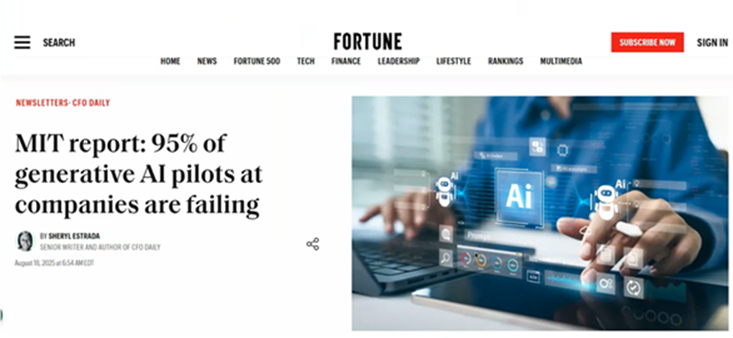
To put it in context, it’s not a technical study or in-depth research report, but rather an analysis based on interviews with a limited number of companies, and it considers a “failure” to be not achieving clear ROI within a few months. Personally, I find that a pretty strict criterion for considering a project as failed. It’s important to note that this doesn’t necessarily mean the projects didn’t work, but that they didn’t generate a clear benefit for the company within that timeframe.
Still, the underlying message is valid: many AI pilots don’t make sense because they’re often launched without clear objectives, simply to justify investment in an AI department. Other times, they overlooked that business processes are complex and full of interactions, so focusing only on Generative AI isn’t enough—you need to combine Gen AI with other types of automation applications as well.
Generative AI Is a Tool, Not the Center of the Universe
In meetings with large companies (IBEX35), I always wonder: does it make sense for them to have independent AI departments? What’s clear to me is that Generative AI cannot automate processes on its own. It needs to be integrated with the rest of the company’s ecosystem (web services, databases, RPA, ERPs, CRMs, email, etc.), manage exceptions with users, and coordinate with other business processes.
That’s why I see Generative AI as just one more tool within a broader set of automation solutions. It’s not a solution by itself, but a component that, when used well, enhances everything else.
Many companies already use process automation solutions that have proven effective. You simply have to add the Generative AI component needed for each process. Most of these solutions already include Gen AI integrations. That’s why I believe the most sensible approach is to continue relying on the teams responsible for Process Optimization (whether they’re called Operational Excellence, Continuous Improvement, Digital Transformation, or something else) and train them in Generative AI, so they can make the most of all available tools.
Something similar happened in the past with the arrival of RPA technology: large companies created dedicated departments focused exclusively on that technology. Today, almost all of those have disappeared and have been integrated into process optimization teams.
Looking Ahead to 2026
The main challenge of Generative AI is its non-deterministic nature. This means that even when you ask several times the same question (same input parameters), it might not always generate the same answer. This characteristic makes automating processes or repetitive tasks difficult, as the lack of consistency can complicate integration into workflows that require predictable results.
That’s why in 2025, most projects have focused on applying Generative AI in specific departments, where consistency isn’t as important; Customer Service (handling support cases, managing information requests, gathering feedback), Marketing (content creation and market research), and IT (software development, support, and cybersecurity).
However, the core business of companies and the majority of repetitive tasks (back office)—where automation typically brings the most value—are not found here. For this reason, I believe we need to change our mindset and accept a certain degree of indeterminacy when using AI, rather than striving for total automation. I think that automating 75–80% of these processes could already provide a significant return on investment. Of course, it’s essential to properly manage the remaining 20–25% of incidents, possibly connecting the process to humans. I hope that next year, we can make the leap to these kinds of solutions!
In the meantime, I still think expectations around Generative AI remain too high. Once they become more realistic, we’ll be able to appreciate its true value: being just another tool—a very powerful one—for automating processes and improving efficiency in different areas.
Wishing you all a great 2026, full of useful projects, less hype, and more concrete results! 🚀