
During my career, I have participated in many Proofs of Concept (POCs) using various software solutions. POCs are a resource sometimes used during the sales phase to demonstrate a series of specific, pre-agreed functionalities.
Since a POC can require significant effort without any guarantee it will result in a sale, we (software vendors) only undertake them when we see a clear commitment to purchase from a client who wants to confirm that the solution will work with their particular business requirements. As a general rule, we do not charge for this work, as our goal is to sell the solution.
A clear alternative to POCs are references, which can be used to verify that the solution works for other clients. We also often do personalized demos or even technical workshops. There are also what we call Pilot Tests, which are real installations on a small scale and in the client’s environment. These tend to last longer and incur associated costs. One could write a whole article just about these presales tools.
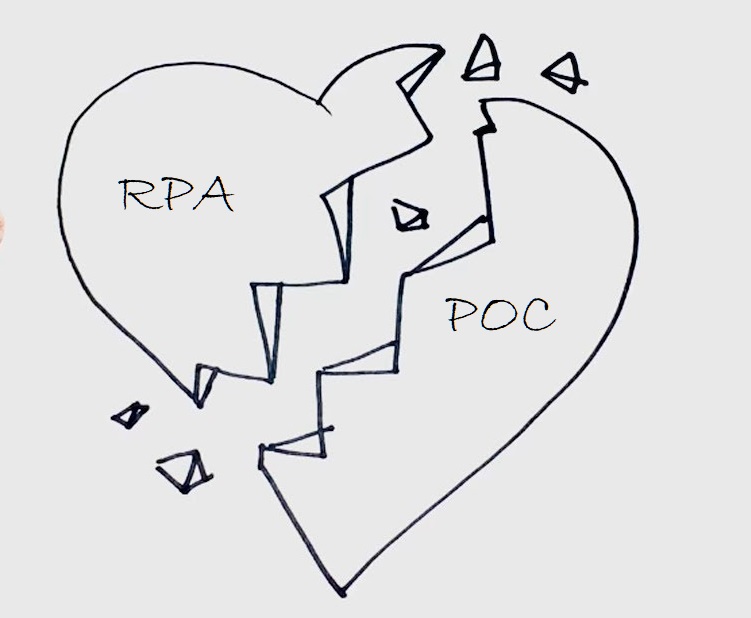
The fact is, the emergence of RPA technology has truly revolutionized digital transformation projects, and it’s something many companies are interested in, as it is a quick and simple way to start automating tasks. For example, in 2019 we averaged two to three new inquiries per week specifically about this technology. If we assume a similar or greater trend among our competitors, and add to this the fact that some RPA vendors now have more and more distributors (some solutions offer free online training or open-source versions), a market is being created in which almost anyone can sell you an RPA solution. Moreover, it’s becoming customary to do a POC for every interested client. That’s why today, the words “RPA” and “POC” are more closely linked than ever. And I wonder why.
Personally, I think it’s all related to the new distributors popping up everywhere. Since they don’t have good references yet, the POC is a good way to earn the client’s trust. In theory, it’s an easy technology to implement. Also, almost all of them charge for their services, so they have little to lose and, at the same time, get training on the tool by implementing a project. Naturally, this means that some POCs don’t turn out well, but it doesn’t matter much since there’s another one waiting the next week. I get the impression that more POCs are being sold than actual final products.
This way of doing business means that if a potential client likes your solution, they’ll end up requesting a POC, because others have offered them one.
Let’s be honest: any of the best-known RPA solutions are capable of automating a specific task. It may take more or less work, but it can be implemented. So, are RPA POCs really useful?
Considering that the AIIM Emerging Technologies Report (2019) indicates that only 3% of companies have managed to scale RPA technology with 50 or more robots, it’s clear that focusing solely on doing a POC for a specific task doesn’t provide the full picture.
In fact, most of the time, only that same task or perhaps one more ends up being automated. This is because the chosen solution doesn’t allow work at a corporate level, or the vendor doesn’t have the experience to help set up a center of excellence or expand the solution.
Therefore, my conclusion would be that a Proof of Concept on a specific task does not always indicate the suitability of a solution. One must also consider how far the product can go at a corporate level and who is implementing it.